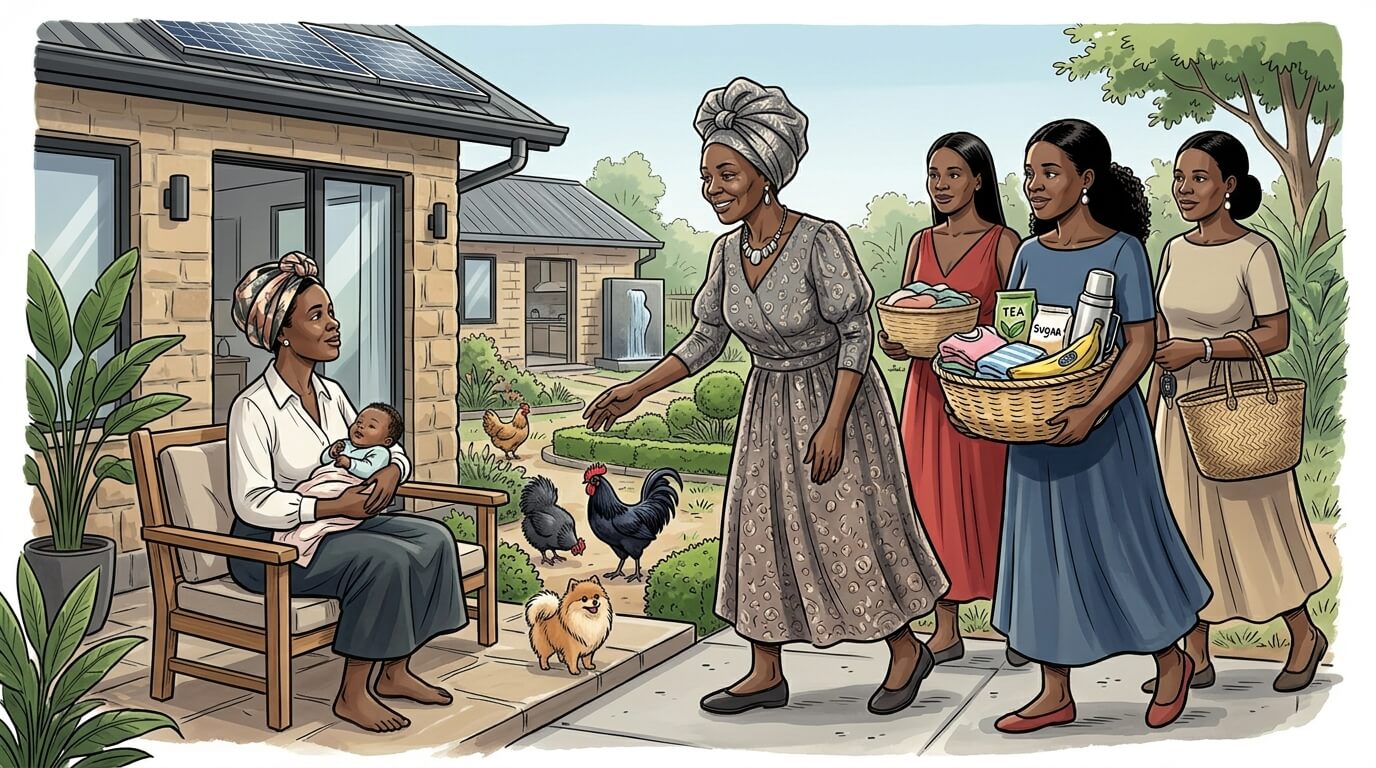
Kutulitsa Mukana is a Maragoli (Logooli) postnatal rite in which a mother formally “releases” her married daughter after childbirth, restoring her social and economic exchange with her natal home. It is both a blessing ceremony and a structured negotiation of kinship obligations, gifts, and recognition between families.
What is Kutulitsa Mukana in Maragoli Culture?
Among the Maragoli of Western Kenya, childbirth does not end with delivery. It initiates a carefully managed period of social restriction and eventual reintegration; a period with great cultural significance as it sets the tone for future realtions between in-laws previuosly only bound by marriage, but now with the birth of a child, by blood. Kutulitsa mukana (literally, “releasing the daughter”) marks the moment a married woman, after giving birth, is formally restored to circulation between her natal and marital homes.
Until this rite is performed, the daughter remains symbolically confined within her marital compound. She cannot exchange gifts with her natal family, nor can she freely visit. This is not a casual restriction of movement or communion. Kutulitsa mukana is institutional. It ensures that childbirth is acknowledged not just biologically, but socially and economically.
Why is the Daughter “Released”?
At first glance, the restriction appears punitive. In practice, it is regulatory. The rite organizes three things: (1) Recognition of the child by the maternal lineage; (2) Activation of reciprocal exchange between affinal families; and (3) Triggering of outstanding obligations, particularly uvukwi (bridewealth-related payments). In other words, kutulitsa mukana functions like a cultural switch. Until it is flipped, the system remains paused. Once performed, flows of goods, visits, and obligations resume.
How is the Ceremony Performed?
The rite is led by the mother of the daughter (now a grandmother, guku), accompanied by a delegation of women. Men do not lead the ritual, but they underwrite it materially.
Sequence of Events
- The grandmother assembles a group of women (often six or more).
- They carry gifts: clothing for the newborn, food items, and household goods.
- The maternal grandfather (guga) finances key provisions: milk, tea, sugar, bread, firewood, and typically four live chickens.
- The group travels to the daughter’s marital home.
- The newborn is briefly taken, bathed, examined, and handled collectively.
- Songs are sung—both celebratory and instructive in tone.
- The child is returned to the affinal family.
- A communal meal is provided by the in-laws.
- Each visiting woman receives a small cash token (traditionally 100–200 shillings).
The Liminal Mother: Food, Restraint, and the Question of Bananas
A woman who has just given birth occupies a liminal state, meaning they are neither fully reintegrated into ordinary social life nor entirely set apart. In Maragoli understanding, she shares this threshold condition with other transitional figures: the convalescent, the recently circumcised, and the bereaved. Each category is subject to regulated movement, controlled diet, and ritual attention.
Within this framework, food is not neutral. It is selected, restricted, and interpreted. While bananas are widely recognized across the region as restorative food for those recovering from illness, their place within kutulitsa mukana remains context-dependent. Oral accounts suggest that if bananas are included in the ceremonial ensemble, only one type of banana sufffices: Ligomia l’Logooli kisigame (the traditional Maragoli banana). The emphasis is not on quantity but on recognition: one bunch is enough. This restraint aligns with the broader logic of liminality. Excess is avoided. Precision is preferred. So what does it take to get it right?
The Economics of Kutulitsa Mukana
What appears as ritual is also a ledger. Contributions, expectations, and returns are reciprocal and tightly structured.
| Actor | Contribution | Return/Benefit |
|---|---|---|
| Maternal Grandmother (Guku) | Leads ritual, mobilizes women | Social authority, lineage continuity |
| Maternal Grandfather (Guga) | Funds goods (live chicken, food) | Receives uvukwi payments |
| Women Delegation | Labor, gifts, participation | Cash tokens, strengthened networks |
| Affinal Family | Hospitality, cash tokens | Recognition, legitimacy of child |
This is not symbolic exchange. It is structured redistribution that lays the foundation for future relations. The ceremony aligns incentives: the maternal side invests labor and legitimacy; the affinal side responds with hospitality and cash; the child’s maternal grandfather’s lineage remains economically engaged through uvukwi. But who carries the load? Well, the ritual is executed by women but financed (partially) by men. This creates a familiar tension. Women are expected to assemble gifts, even when household resources are controlled by husbands. However, here we find another example where the gendered realities of Maragoli culture are apparent. Chickens in the yard, for example, are often considered the man of the home’s property, though women hold delegated authority.
When Does the Cycle End?
Kutulitsa mukana is not a one-time event. It repeats with each childbirth until a terminal rite is performed: kuruta mukana. At a certain stage in the daughter’s reproductive life, a final “release” is marked by a larger ceremony in which the maternal relations of the child visit for a bigger ceremony with more pomp and grander gifts. In between the first kutulitsa mukana and kuruta, a presentation of a decorated bull adorned with flowers across its horns, neck, and body, the bull signals continuing relations and can be considerd part of uvukwi.
What Happens After Release?
Once released, the daughter resumes visits to her natal home. She does not come empty-handed: Tea and sugar, cash gifts for both parents and other household items. These gifts carry meaning. They signal that she is “from people, not trees”, that she is supported, valued, and properly married.
In return, she receives whatever produce freely available at her natal home such as maize and firewood. More importantly a chicken, often a pullet or cockerel matched to their sex, is formally presented to her child. If she is formally married, even with uvukwi paid in part, she must take a live cockrel that she must slaughter for her husband to enjoy once she gets to her marital home. The exchange serves as proof of functioning kinship ties.
While kutulitsa mukana is specific to the Maragoli, its logic echoes globally. Postnatal rituals often combine simillar goals including physical recovery of the mother, social recognition of the child and reintegration into community networks. For example, in parts of South Asia, the ceremonial shaving of a child’s hair (often between the first and third year) marks purification and growth. In Latin American traditions, postpartum “closing of the bones” rituals focus on the mother’s physical and emotional restoration through massage and binding techniques.
Why Kutulitsa Mukana Still Matters
Strip away the songs and symbolism, and what remains is social infrastructure. Kutulitsa mukana regulates movement, exchange, and obligation between families. It ensures that childbirth is not an isolated event but a trigger for social accounting. In modern terms, it performs functions that institutions often fail to deliver: recognition, redistribution, and relational enforcement. And like any system, it evolves. Cash replaces food in some cases. Timelines compress. But the underlying logic holds.
Refrences
Abwunza, J. M. (1991). Logoli Women of Western Kenya Speak: Needs and Means. Ph.D. dissertation: University of Toronto, Toronto, Canada / University of Nairobi, Nairobi, Kenya. http://erepository.uonbi.ac.ke/bitstream/handle/11295/41781/Abwunza_Logoli%20Women%20of%20western%20Kenya%20speak.pdf?