
Without doubt, mom’s food is the bomb! And if there’s anything better, then it has to be at those huge family dinners, often over Christmas holidays, when grandma whips up a delicacy like seveve ga’ amabere, enyama esike, muduya or engokho ye munyu kwa lukhaye.
I mention these Luhya traditional vegetables and meat delicacies for obvious and not so obvious reasons. A luhya’s love of engoho is a well known, well chewed on, well satirized affair. But less known is muduya’s place among luhya traditional foods. Let me put it this way. Growing up, it’s only ingokho and muduya that was shared among brothers.
They’d slaughter a cock, stew it, and then send us the children (my cousins, siblings and I ) to deliver the food and spread the love around the village. We would be dispatched with small servings to each house of the extended family: isundi and shirenge to baba msakhulu who lived across the river, indangulu and ligoti to baba mtiiti across the fence. With muduya, it was no different – a bowl of steaming muduya here, there.
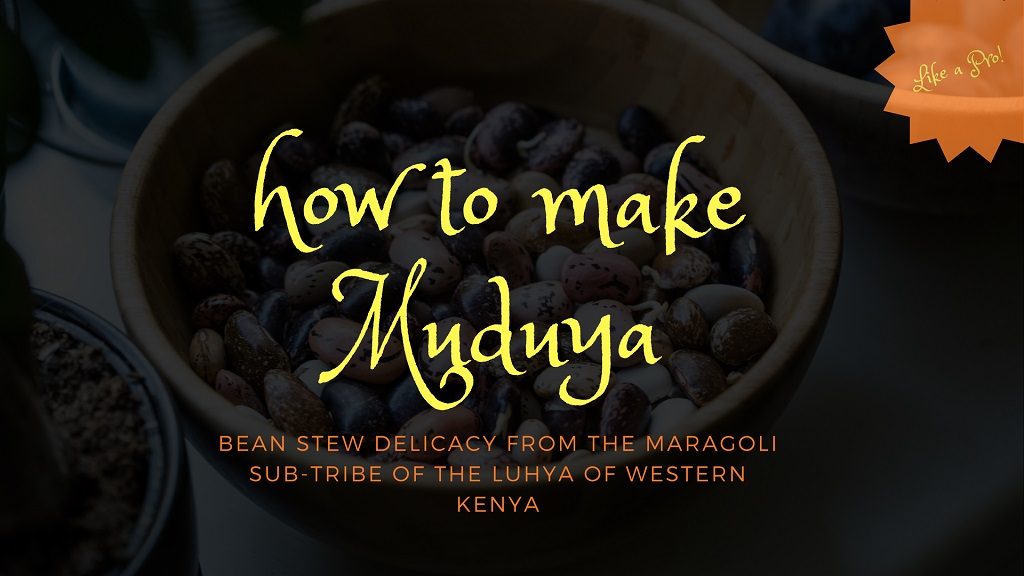
How to make muduya
Muduya is a bean stew delicacy that's treasured among the Maragoli sub-tribe of the Luhya of Western Kenya. It packs a punch in flavor, yet no spices are involved in its preparation. Muduya is best served with ugali and a side helping of fresh vegetables or vegetable salad.
- 250 millimeters Munyu Musherekha (A traditional lye made by leaching ash. )
- 250 grams Split decorticated beans (Slightly roasted, split, decorticated dry beans of whichever variety. )
- 1-3 liters Water (Use most to boil the beans and hold some to be used during cooking.)
- 1 Pinch Salt (Or to taste.)
Cook the split decorticated beans by bringing them to a boil.
Add the salt, munyu musherekha and stir continuously until it becomes a thick paste
'Stewing' of 'frying' the muduya (optional)
Fry tomatoes and onions till soft in cooking oil of your choice. Add garlic, ginger or any other spices of your choice.
Add the muduya and bring to a boil stirring along the way to avoid it sticking to the bottom of the pan.
Quick facts about omunyu musherekha
- Munyu musherekha is an acquired taste. Too much gives food a bitter alkaline taste.
- Too much is a function of both the quantities added, and the strength of the lye. To guesstimate the strength of lye, dip a finger in the solution and taste.
- A strong alkaline taste denotes strong munyu musherekha.
- The ash is commonly of the dry maize cob, sun-dried peels of the plantain or sun-dried bean stalks and pods. It is colloquially thought that the strength of lye increases down that scale.
How to prepare split, de-corticated beans for cooking muduya
- Dry beans of whichever variety, are slightly wet with water.
- Then in a dry pan, roasted over a fire, being tossed periodically to avoid burning- much in the manner of how groundnuts are roasted.
- The bean’s testa is stripped of the bean by shearing action using the two-stone method that was traditionally used to grind seeds. You can achieve the same effect by rolling the beans under a rolling pin.
- Store purchased decorticated beans may need to be tossed on a pan to lightly roast them so as to tease out the flavor.
- The ‘more clean’ the beans, the better suited they are for making muduya, the traditional luhya delicacy.