
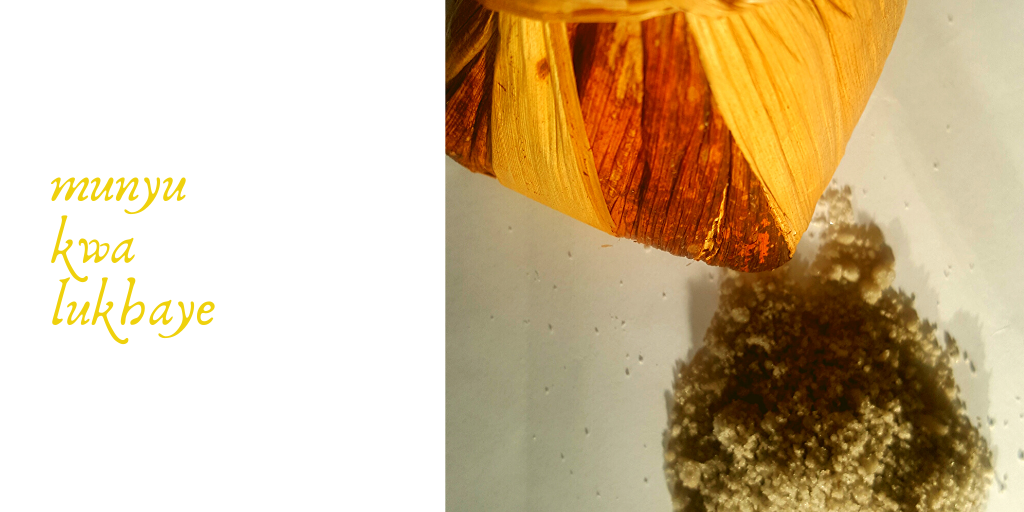
What is munyu kwa lukhaye? In this post we not only provide answers but also offer a short tutorial on how to make munyu kwa lukhaye. We also list dishes that when cooked with munyu kwa lukhaye, are sure to a delight.
Across the 18 sub-nations that make up mulembe nation, the word munyu refers to soup. Munyu mushelekha (Lwidakho) or simply munyu also means a traditional lye derived by leaching a variety of dried plant matter. The most common of which are: maize cobs, pods and vines from beans, peelings of green plantains and a special type of reed that grows in swampy areas. Nutritionally, all types of munyu are potassium rich.
Lukhaye (Lubukusu) on the other hand means the honor of a woman. Therefore, omukhaye is a respectable lady. By honor, we talk of the honor of accomplished women in society. Women of the stature of the Akoko lineage from the literary masterpiece The River and the source by Margaret Ogola. Or even women like Nabukelembe, the mother to Mutonyi the famous Bukusu seer known for his accurate prophesies on war based on everyday things like chingayu. Dare I say women like the pioneer Prof. Julia Ojiambo from Funyula or Dina Nasiku Kibunguchy of the Kwa Dina fame. Really, women like our grandmothers who are matriarchs in their own right.
Types of munyu
Based on the type of dried plant matter it’s derived from, munyu can be described as such. Therefore, there is munyu gwa masogoro (Maragoli), meaning munyu from maize cobs, so on and forth. The other way that one can classify munyu is on its form during use. The common version of munyu that’s is the liquid leeched is what you’ll find being referred to as munyu mukhelekha/musherekha.
The other type is munyu kwa lukhaye. Growing up, mother would send the nine of us to the river to being head full of reeds from the banks. The specific reed she sent for was referred to as kamakengelie (Lubukusu). Kamakengelie are water hungry reeds. Their presence is a positive indication of a swamp. Mother would then sun dry the reeds and chose a time, usually the evenings, to burn them to ash.
How to make munyu kwa lukhaye
Using a homemade apparatus consisting of a receptacle with a tin atop whose bottom consisted of a mesh of small perforations, she would then extract the lye from the burnt ashes. We would then be given the task of boiling the extracted lye. The fluid would boil to oblivion. As the fluid disappeared, small crystals would begin forming at the edge of the pan.
Traditional Luhya dishes that pop with munyu khwa lukhaye
For munyu mukhelekha (Lubukusu), the lye is perfect for cooking Luhya traditional vegetables and dishes like lisebebe, mitoo and muduya. However, munyu kwa lukhaye, given the difficulty is accessing the reeds and the craft needed to crystallize the salt, it was used to prepare special meals. Like when making kienyeji chicken for special occasions like when in-laws visited. I also found mum’s enyama esike, duck and tsisindu made by this salt heaven on a plate. For my mum’s case, she prepared munyu kwa lukhaye on those lovely days preceding father’s coming home for his annual leave.
Mulembe Food
[embedyt] https://www.youtube.com/embed?listType=playlist&list=PLuBfDbs_1hVtZsnf7DW2_FE-O8k5aCfKu[/embedyt]