
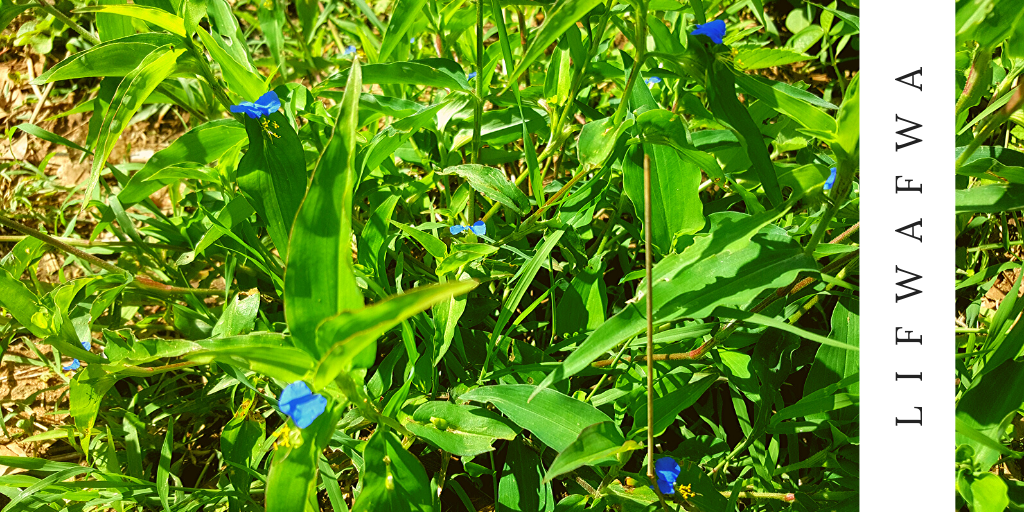
Lifwafwa/sikayangaya/linyoronyoro/linyolonyolo is an ever green plant that is today considered more of a weed than an easy to vegetable that our grandfathers loved to hate.
It grows in fertile soils and spreads fast when the land is tilled. I remember growing up mum would insist that when tilling land, to be particular with lifwafwa. She would only consider the land well tilled if all the linyoronyoro had been gathered out of the farm or at least be placed in a heap at the edge of the farm.

Quick facts on lifwafwa also known as linyoronyoro/ linyolonyolo or sikayangaya
| Scientific Name: | Commelina benghalensis |
| Common Names | Benghal dayflower, tropical spiderwort, or wandering Jew. |
| Local Names | Linyolonyolo (Bakhayo), lifwafwa (Bukusu), lifwafwa (Tachoni), linyoronyoro (Maragoli) |
| Key Characteristics | It is a common herb native to Africa and Asia that creeps on the ground. In wet conditions, some of its branches are ascending. Lifwafwa is evergreen with hairy leaves that are oval in shape. It bears flowers that are blue in color. |
This is because lifwafwa grows from cuttings of its rhizome roots. Therefore, the more one chopped it when tilling, the more it propagated. But it always hasn’t been this way. Lifwafwa has a plant of immense cultural value among the Luhya. To illustrate it’s value, consider its uses as follows.
Lifwafwa aka linyoronyoro the laxative
When I got my firstborn, I was young and naive as most first time mothers are. I am reminded of a particular instance when the baby was teething, when it had a troubled tummy. We had just started weaning it and it had not pooped for a couple of days.
It happened that this occured when I was back in the village at mum’s. As soon as mum got wind of the situation, she sent my younger sister to the farm with clear instructions. Go get a young shoot from lifwafwa, nip it at the inter-segmental joint and bring it over. Once my sister brought the shoot of linyoronyoro, my mother allowed it to ooze it’s colorless mucilage.
Then she asked me to gently insert the lifwafwa shoot into my baby’s anus and to keep tickling the anus. Believe me when I say that I was not prepared for the outcome. Soiled I was, but it was nothing short of terrific. The baby opened its bowels immediately.
A taboo plant for pregnant women not yet at term
Among the Bukusu, lifwafwa alongside other slimy vegetables like mulenda were a taboo for pregnant women who were yet to be at term. This was because these vegetables were that to stimulate prostaglandins leading to softening of the cervix and thus precipitating labor. It was not only lifwfwa that was forbidden, but also other bitter vegetables believed to cause stomach pains like namasaka (Black nightshade) and Esufwa.
Lifwafwa in a Bukusu folk tale
In the Bukusu folktale The Boy Who Ate The Elephant’s Rumps, we meet a boy is tricked by a a herd of elephants to take care of their rumps. The elephants were going to an important party and felt that their rumps would make it hard for them to dance. In a vain quest to be the best dancers at the party, the elephants cut of their rumps and entrusted them with the boy. But as the following passage reveals, all didn’t go according to plan.
Filled with greed, the boy presented the rumps to his mother This was in spite of the threats the elephants had issued to the boy. The boy’s mother not only praised the boy and thanked Wele for their good fortune, but also chided the boy’s father for neglecting them to the extent they had to feed on linyolonyolo like the forsaken.
If you had not known how the elephant lost her rump, now you know.
Mother!” called the boy. “Guess what I have got for you today.”
“What is it my son?” replied the tired woman. “Did you get any luck with your bird-traps?”
“Oh, no!” cried the boy. “You won’t believe your ears. We have here enough meat to feast on for many days to come; see.”
“Oh, my son! What could I do without you? Your father has neglected us for a long time. He provides us with neither meat nor milk, and so we have to go on living on lifwafwa like the outcasts of the land. He only cares for his other woman while we sniff about for signs of kuronya. I tell you my son, this is a gift from God himself.”
Lifwafwa the vegetable
The blog equator.com has a fascinating story on lifwafwa/ linyoronyoro. The author claims that during the drought that followed the second world war, the Luhya rediscovered linyoronyoro as a vegetable. This is because unlike other traditional Luhya vegetables, lifwafwa does not dry up during drought. Thus, as a result of its availability then, it became immensely popular as away to escape hunger.
Therefore it followed that linyolonyolo was mixed with kunde or the equally slimy nderema. However as the drought progressed, it became preferable (or feasible) for the lifwafwa cooked alone. Especially when the lifwafwa was fried using some liquid cooking oil packed in a debe which was then being distributed for free.
Going by this story, it is unmistakable why lifwafwa was considered by the Luhya as a food for troubled times or rather, a meal for the down trodden. In fact, there is a Luhya folk song that reminds us of this. This is the Maragoli version of the folk song.
Mama be tsimbindi tse kimiza,
Nzie, Nzie, Nzie
Kilavula kitenzo ngani Inzara yakita nu guli kanyama
usyazenga na ugonga.
This song is praise to Luhya Gods for bringing rains that will save the community from the pain of linyoronyoro. With the coming of the rains, a child asks its mother to give them the seeds of cow peas so that they can go and sow. In this song the more palatable cow peas, a mere vegetable that’s indigenous to the Luhya, is compared to meat.
Linyolonyolo the medicinal plant
Aside from its use as a laxative as described above, the lifwafwa plant has more medicinal uses. When mixed with the traditional vegetable nderema, its raw juice was used to treat coughs in children. Further, in other cultures it had more medicinal uses.
The Zulu used it as a poultice to sooth wounds. Our southern brothers also take lifwafwa to manage high blood pressure. The Sotho use lifwafwa to treat barren women. Across world cultures, lifwafwa has the following medicinal uses. It is used to treat:
- sore throats,
- burns,
- sore eyes,
- dysentery and stomach pains,
- rashes and leprosy,
- In Tanzania, dried leaves used for oral thrush in children;
- In the Phillippines, it’s used to treat urethral pain;
- Lifwafwa in India is as demulcent, refrigerant and laxative;
- In Madagascar, leaf decoctions are taken for malaria;
- The leaves are also used as animal fodder.