
When Elijah Mwangale used a Bukusu proverb when presenting to parliament the report on J.M Kariuki’s murder he aimed for effect. We explain
He was larger than life. Bungoma KANU chairman 1976 to 1993, Bungoma East Member of Parliament 1969 to 1992, cabinet minister Labour 1979 to 1981, minister Tourism and Wildlife 1981 to 1983, minister foreign affairs 1983 to 1987, minister livestock development 1987 to 1988, minister Agriculture 1988 to 1992; the brobdingnagian Elijah Wasike Mwangale always had a Bukusu saying not so far from his lips. Fondly known to his constituents as Bwana Kiko, the man who stepped into Masinde Muliro’s boots in Bungoma politics is responsible for placing into the books of history the virtue of the cheeky Bukusu proverb: Namunyu kabolela libale ali wakhasila waulile.
Translated, in English the proverb says: the hyena told the stone that however much you (the stone) remain silent, you have heard. At a period of high national tensions following J.M Kariuki’s murder, this son of the soil from Matili village, Kimilili perfectly and succinctly gave a notation of the times.
Born into the Basombi clan, the late Elijah Mwangale (1939 -2004) was revered as a reincarnation of a great Bukusu warrior, his ancestor, the mighty Lusweti. Indeed, some of his constituents considered Elijah a prophet. Before you dismiss Elijah Mwangale’s larger than life status, allow us to regale a legend that is dear to the Basombi.
Mwangale The Man
The following legend of Lukowa Titi not only identifies a people, but lays a foundation to understanding Elijah Mwangale. This legend leads us into the bosom of the man’s heritage. We come to appreciate how Bukusu culture became a tool that shaped Elijah Mwangale’s worldview.
Just like his ancestor Lukowa Titi, Mwangale relied on his culture to maneuver with guile form a tight spot. Thus tanks to the acts of these mesn, through legend and history, we begin to appreciate the wisdom of the saying: Namunyu kabolela libale ali wakhasila waulile.

How the legend of Lukowa Titi, J.M Kariuki’s murder, Elijah Mwangale’s daring move in parliament of 1975 finds meaning in the Bukusu proverb: Namunyu kabolela libale ali wakhasila waulile
The Basombi had a man by the name Lukowa Titi who was once brought before the colonial administration in Kakamega. This man faced allegations of practicing witchcraft. This was in the days when Bungoma was still an outpost sub-servant fully to Kakamega the colonial provincial headquarters.
Facing prison, Lukowa Titi insisted that he was no witch but only had powers to control hailstones. In a way, parallels can be drawn between Lukowa Titi situation and Elijah Mwangale’s crux years later in 1975. Hon. Mwangale as chair of the Parliamentary probe committee to the death of rising political star J.M Kariuki.
J.M Kariuki’s death was a hot potato and Mwangale had a difficult task in his hands. The tension that J.M Kariuki’s murder had caused in the country sat in one corner. On the other corner were the loud whispers that the administration of the day was responsible for J.M’s cruel death.
In deed it is reported that the presidency instructed the Mwangale led committee to expunge powerful names from the final report. Therefore, with the world watching, Mwangale’s task was one that also included preserving the dignity of parliament. On a personal note, just like Lukowa Titi, his reputation and life’s work were on the line.
Between a rock and a hard place
Lukowa Titi found himself in a situation similar to that of Mwangale. Under the watch of a powerful government not afraid to flex its muscles , he needed to: manage tensions back home as he was their leader, preserve the dignity of an institution (in his case, Bukusu culture) and to save his own skin.
Titi chose the dramatic path. So he asked to be excused and be allowed to access Kakamega forest so as to prove his innocence. He emerged shortly after under the deluge of hailstones, but with no rain!
Hon. Elijah Mwangale chose the less dramatic – mere words. His choice of words? The obstinate, now widely quoted Bukusu proverb: Namunyu kabolela libale ali wakhasila waulile.
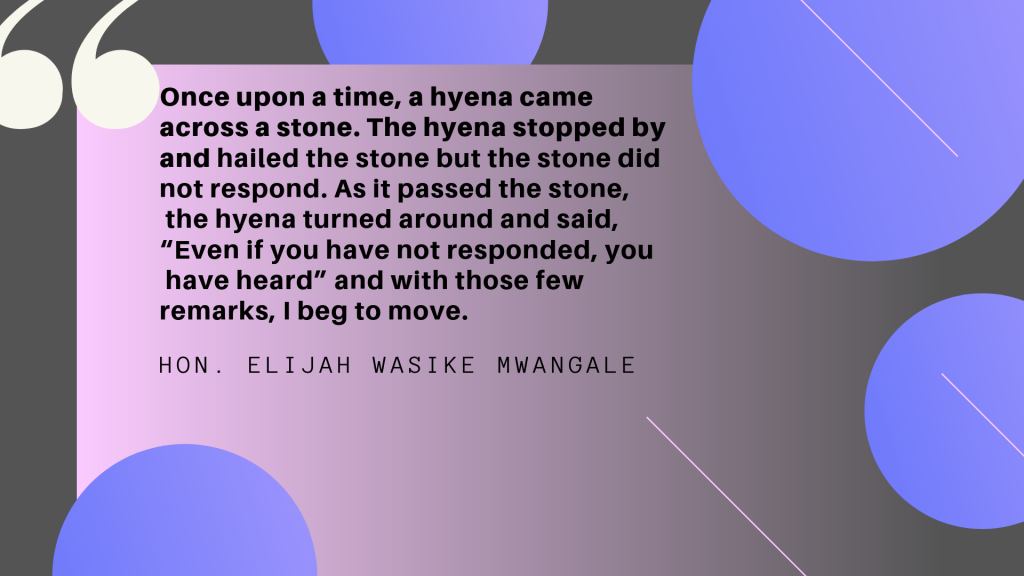
“Once upon a time, a hyena came across a stone. The hyena stopped by and hailed the stone but the stone did not respond. As it passed the stone, the hyena turned around and said, “Even if you have not responded, you have heard” and with those few remarks, I beg to move.”
Elijah Wasike Mwangale’s closing remarks to a hushed house in 1975 whilst presenting the report by a Parliamentary Select Probe Committee into the assassination of J.M Kariuki.
For those in the know, it is obvious to them that both Lukowa Titi and Mwangale did a uniquely Basombi thing: They were characteristically brave in the face of adversity. Quite frankly, considering the circumstances, such bravery is not only rare but not unique.
Especially given how these two gentlemen chose to spoke truth to power in extremely difficult circumstances. More so, with guile and a wisdom that can only be gleamed from a body of knowledge unique to a people.

More Bukusu Proverbs and Sayings
Mulembe Nation is home to the Internet\’s largest collection of Bukusu proverbs and sayings; including tit bits on their use and meaning. Plus links to delightful and insightful stories on our heritage and culture.
Sources
- A Political Biography Of Elijah Wasike Mwangale: 1939-1992 By Aggrey Wafula Mabolo. From University of Nairobi research archive.
Ekazi endayi Sana..tilila abwenao.